
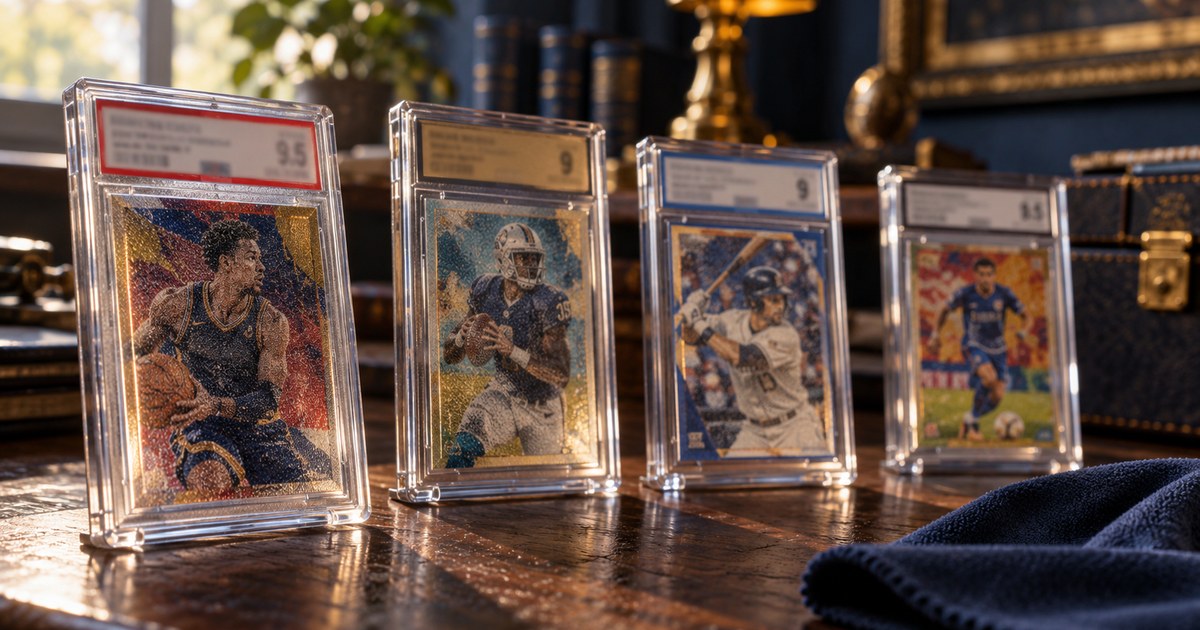
Choosing between card grading companies feels like the big decision once a card looks good enough to send in. Fee tables make it look like a price comparison. For a sports card owner, it is mostly a resale question, and for many cards the honest answer is that no grader is worth paying at all.
Four card grading companies handle almost all sports cards: PSA, Beckett (BGS), SGC and CGC. PSA’s slabs generally resell for the most, and it grades the large majority of cards. SGC is respected for vintage, BGS for its subgrades on high-end modern cards, and CGC is growing. PSA, SGC and Beckett now share one parent company.
That last point changes the old “which grader” debate more than any fee change, so it is worth starting there.
Who owns the card grading companies now?
Collectors, the parent company of PSA, acquired SGC in early 2024, according to ESPN. In December 2025 it announced it was buying Beckett as well, with Beckett staying an independent brand inside the Collectors group. ESPN, citing GemRate data at the time of the Beckett deal, reported that PSA handled more than 75% of items graded in a recent week, CGC just over 18%, and Beckett nearly 3%.
For a seller, the practical effect is simple. Three of the four big names are now one company, and the market’s resale preference already leaned heavily toward one of them. CGC, part of the separate Certified Collectibles Group, is the main independent alternative.
PSA: the resale default
PSA’s advantage is not that its graders see more. It is that buyers pay more for its slabs. The Card Shop Finder’s comparison describes PSA as commanding higher resale prices than any other holder across most categories, and puts the typical gap at 20 to 50% over BGS or CGC for the same card in the same grade. That range is a guide’s estimate, not a rule, and it varies by card and era.
PSA uses a single 1 to 10 grade with no published subgrades. Our explainer on what PSA 10 means walks through each step of the scale, and our breakdown of PSA grading costs covers the current fee tiers.
Beckett (BGS): subgrades and the Black Label
Beckett’s distinguishing feature is four subgrades printed on the label: centering, corners, edges and surface, which average into the final grade, as the Card Shop Finder’s comparison explains. A card that earns a 10 on all four receives the Pristine 10 Black Label, which the Card Shop Finder calls one of the most prestigious designations in the hobby.
That premium is real at the top of the market, on high-value modern cards where a Black Label can far outsell other slabs. On a mid-value card, the subgrades mostly tell you why the card got its grade, which is useful information but not usually extra money.
SGC: the vintage specialist
SGC is known for its black “tuxedo” holders and has a long reputation with vintage collectors. The Card Shop Finder describes it as especially strong for vintage sports and a legitimate PSA alternative for vintage baseball, often at better prices. It still grades under its own name despite the change in ownership.
If the card is pre-1980 and you plan to keep it, SGC is a reasonable choice. If you plan to sell it, compare sold prices for the same card in both PSA and SGC slabs before deciding.
CGC: the independent
CGC built its name grading comics and later moved into trading cards. Its share of sports grading has grown, but the Card Shop Finder notes that it still trails PSA in sports, and that its resale premium on sports cards is lower than PSA’s. CGC is a stronger choice for trading card games than for sports cards today.
How to choose between them
Ask the questions in this order:
- Is the card worth grading at all? For most base cards, the fee costs more than the grade adds. Our guide to whether grading is worth it has the math.
- Are you selling or keeping? If selling, follow the resale premium, which for most sports cards means PSA. If keeping, pick the slab you like and the turnaround you can live with.
- Is it vintage or modern? For vintage, SGC is a real alternative. For modern high-end cards with a shot at perfection, BGS subgrades can matter.
- What do sold prices say for this exact card? Search sold listings for the same card in each slab at the same grade. That comparison beats any general rule.
Whatever you choose, verify slabs you buy. Our guide to verifying a PSA cert number covers the steps, and every major grader offers a similar online lookup.
The cheapest grading company is the one you skip
Most cards that come out of a box or binder will never earn back a grading fee, from any company. The useful first step is not choosing a grader, it is finding the few cards that deserve one.
RookieScan identifies the player, set, year and card number from a photo, flags parallels, reads condition, and gives a market-based range for the grade the card realistically sits in, so you can see whether a graded copy is worth meaningfully more before paying anyone. What is my sports card worth explains how those ranges are built.