
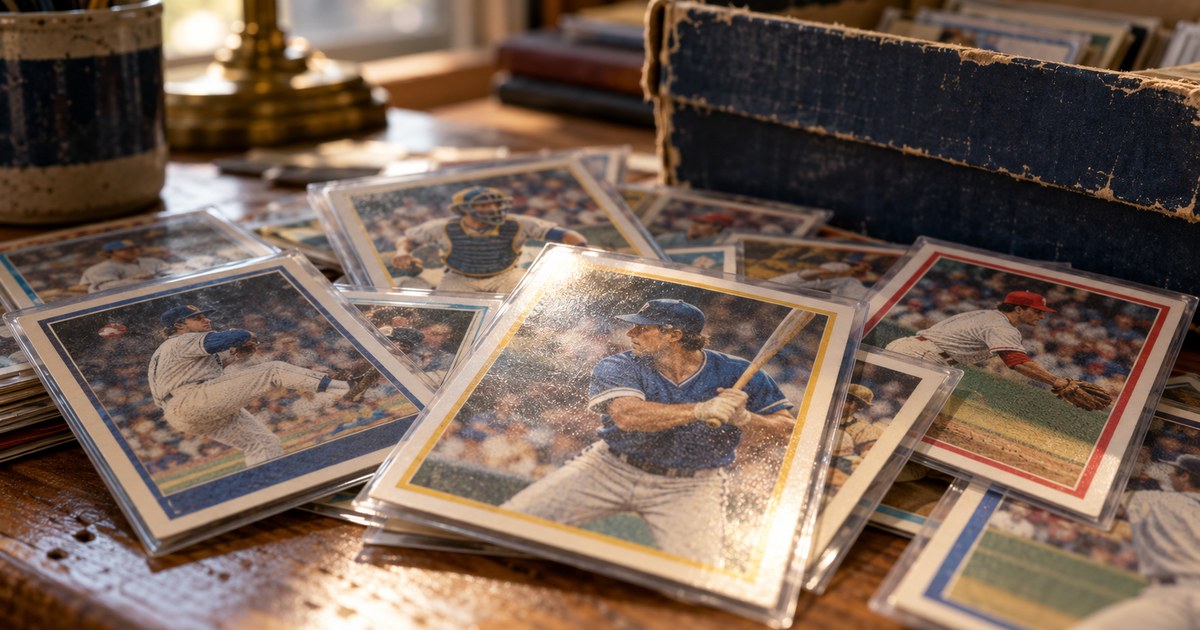
A Barry Bonds rookie card is one of the most common finds in a box of late-1980s baseball cards. He is the career home run leader, his rookie year landed right as card companies began printing at enormous scale, and that combination produced millions of copies. If there is a Bonds rookie in your box, it is very probably the common one.
Barry Bonds has several rookie cards from 1986 and 1987. The one most people own is the 1987 Topps #320, which sells raw for a few dollars to the low teens. The versions with real money in them are the scarce ones: the 1986 Topps Traded Tiffany #11T, the 1987 Topps Tiffany, and the Canadian 1987 O-Pee-Chee #320.
The rest of this guide is about telling those apart in your hand, because the difference between them is small to the eye and large on a sold-price page.
Which Barry Bonds rookie cards exist?
Bonds debuted with the Pittsburgh Pirates in 1986, after the regular card sets for that year had already gone to print. That is why his first cards came in the late-season update sets, and why collectors still argue about which one counts as the “real” rookie. Old Sports Cards lists these as his rookie cards:
- 1986 Topps Traded #11T, sold in a boxed set rather than in packs.
- 1986 Fleer Update #U-14, also a boxed update set.
- 1986 Donruss The Rookies #11, a boxed rookie set.
- 1987 Topps #320, the pack-issued card most people pulled.
- 1987 Fleer #604, 1987 Donruss #361 and 1987 Leaf #219.
- 1987 O-Pee-Chee #320, the Canadian version of the Topps card.
Purists favor the 1986 update cards because they came first. In practice, the 1987 Topps is the one in shoeboxes, because it came in ordinary packs sold everywhere. Once you know which one you have, the rest of the sort is quick.
What is a 1987 Topps Barry Bonds worth?
Not much in raw condition. Rookie Card Prices, in data updated in September 2026, put a raw 1987 Topps #320 at about $3, a PSA 8 at about $18 and a PSA 9 at about $50.
PSA 10 is where the numbers jump, and where sources disagree. Old Sports Cards cites figures between about $350 and $750 for a PSA 10, while Rookie Card Prices puts it near $950. Either way, a gem mint grade is a narrow target: Old Sports Cards counts about 31,000 copies of this card graded by PSA, and only about 1,800 of them earned a 10.
The broader reason is the era. The late 1980s are the heart of the junk-wax years, when production was so high that almost no base card from the period became scarce. Our guide to cards from 1987 to 1994 explains why, and the same story played out with Ken Griffey Jr’s rookie cards two years later (our Ken Griffey Jr rookie card page has the details on his one valuable rookie).
Which Bonds rookie cards are actually valuable?
Three versions carry real money, and none of them is the card most people have.
The 1986 Topps Traded Tiffany #11T. Topps produced a parallel version of its Traded set on higher-quality stock in much smaller quantities, sold through hobby channels. Old Sports Cards puts a PSA 10 of the Tiffany Bonds at roughly $10,000 to $14,500. Wax Pack Gods, whose figures are based on PSA 10 sales, notes the Tiffany sells for 20 to 30 times the regular Traded card in that grade.
The 1987 Topps Tiffany #320. The same idea for the 1987 set. Old Sports Cards places a PSA 10 at roughly $3,000 to $3,900, and Wax Pack Gods puts the Tiffany at 8 to 10 times the base card’s PSA 10 price.
The 1987 O-Pee-Chee #320. The Canadian version of the Topps card, printed in far smaller numbers. Wax Pack Gods reported that PSA had graded about 1,100 copies as of February 2022, against more than 17,000 of the Topps card at the time, and placed PSA 10s at $18,000 to $20,000. Old Sports Cards cites figures between about $12,000 and $27,500.
These record-level numbers belong to the scarce versions in gem mint grade. The card a reader typically holds is the regular Topps in a lower grade, which is a very different market.
How to tell a Tiffany Bonds from the regular card
The Tiffany and regular cards share the same photo, number and design, so the check is in the card stock and the back.
- Look at the front surface. Tiffany cards were printed on glossy stock. Tilt the card under a light: the Tiffany front has a smooth shine, while the regular card has a flatter, slightly rougher finish.
- Look at the back stock. Regular Topps backs from these years sit on grey-brown cardboard. Old Sports Cards notes the 1987 Tiffany back looks noticeably whiter and brighter.
- Check the small print on the back. On the 1987 Tiffany, Old Sports Cards says the “PRTD. IN U.S.A.” line beside the Topps copyright is missing. On the 1986 Traded Tiffany, the two small stars in the lower-left corner of the regular back are absent.
For O-Pee-Chee, the logo is the giveaway: the card carries the O-Pee-Chee name instead of Topps, and the back text appears in both English and French.
Does grading change the answer?
Only for the right card in the right condition. With tens of thousands of regular Bonds rookies already graded (Old Sports Cards counts more than 64,000 of the 1986 Topps Traded alone), a PSA 8 or PSA 9 of a base card adds little over its raw price. The jump from 9 to 10 is where value concentrates, which we explain in PSA 9 vs PSA 10.
A sharp-cornered, well-centered Tiffany or O-Pee-Chee is a different decision. Those are the cards worth grading, after you have confirmed which version you have.
Check yours before you sort
The fastest sort is the one above: confirm the set and number, then check the stock and the back for Tiffany or O-Pee-Chee signs. A regular 1987 Topps Bonds is a nice card to keep and, raw, worth only a few dollars to sell. A confirmed Tiffany or O-Pee-Chee deserves a closer look at condition.
RookieScan identifies the player, set, year and card number from a photo, flags parallels and variations, reads condition, and gives a market-based range for the grade the card realistically sits in. What is my sports card worth explains how those ranges are built.