
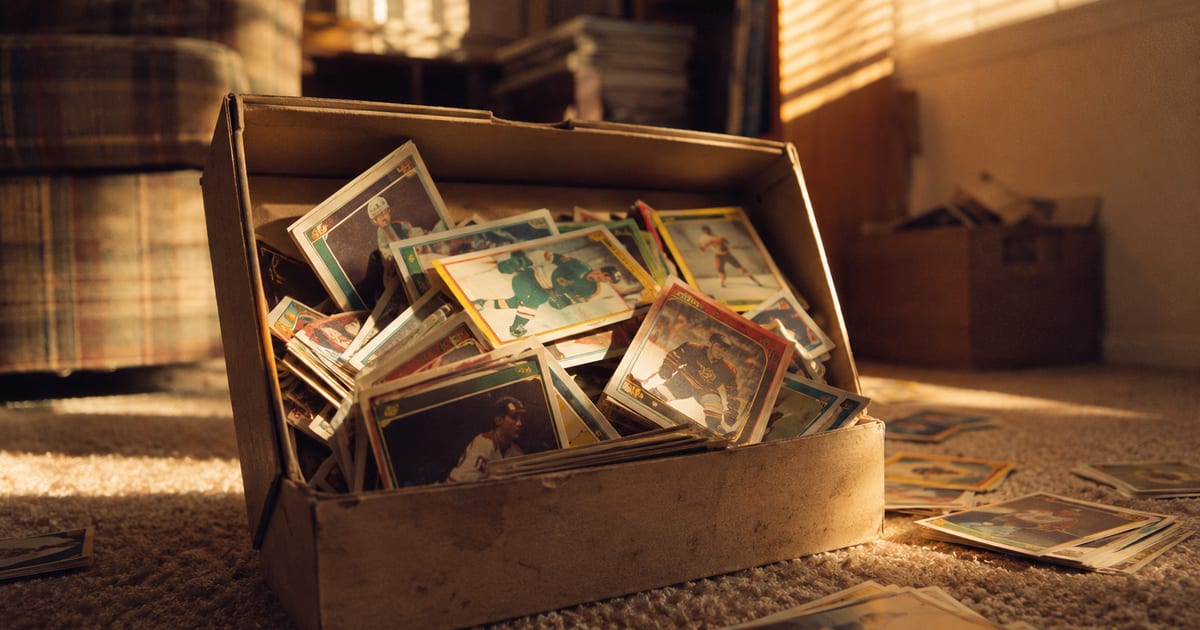
Here is the sentence most sites won’t lead with: if your cards are from the late 1980s or early 1990s, the overwhelming majority of them are worth close to nothing. Not because those years were a bad time to collect, but because of simple arithmetic. Understanding that arithmetic is also the fastest way to spot the real exceptions, and they do exist.
How many of these cards actually exist?
Card companies call this stretch, roughly 1986 to 1993, the junk wax era, and the name is earned. By 1986 alone, Topps had produced over a billion cards. A year later, Topps was printing an estimated 2.5 million copies of each individual card in its 792-card set, which works out to roughly 2 billion cards from Topps in 1987 by itself, before Donruss, Fleer, Score, and Upper Deck are even counted. Even a card as iconic as the 1989 Upper Deck Ken Griffey Jr. rookie, printed over that product’s three-year shelf life, is estimated at around 2 million copies of that single card.
Multiply that kind of print run across five manufacturers and eight years, and the arithmetic explains everything else in this article.
Why did companies print that much?
Simple: demand looked bottomless, so supply chased it. Collectors and parents who remembered how 1950s and 1960s cards had appreciated treated the late-1980s boom the same way, buying wax by the case in hopes of funding a kid’s college education. Card companies expanded production to match, and for a few years the whole hobby behaved like a growth market. It wasn’t one. Supply kept climbing well past what collectors could ever absorb, and the 1994 players’ strike gave the bubble its final push, closing card shops and leaving a generation of collections worth a fraction of what buyers had expected.
So is my card really worth nothing?
For a raw, ungraded common in typical handled condition, usually yes, worth close to nothing beyond nostalgia. But “worthless” is not universal even inside this era, and the most famous card of the period proves the point on both ends. A raw 1989 Upper Deck Griffey in decent shape has recently traded for roughly $75 to $125, with sharper raw copies fetching less, around $15 to $30. Graded PSA 9, the same card runs closer to $400 to $425. Graded PSA 10, gem mint, it becomes a different card entirely, having started 2025 around $2,500, then climbed through $5,300 and $5,999 sales by late 2025, and currently sitting closer to $4,900 to $5,100. That is not one card with one value. It’s the same print run split into wildly different markets by condition alone.
Where the real exceptions live
Nearly all the value hiding in a junk-wax collection concentrates in three narrow places.
Gem-graded stars. As the Griffey numbers show, the same overproduced rookie is worth pocket change raw and thousands of dollars in a true PSA 10. The catch is that gem grades are genuinely hard to pull from print runs this large and this inconsistently cut, so most raw copies will not get there.
Error cards. Printing mistakes that slipped past quality control are the one category where junk-wax scarcity is real, because the mistake itself was never mass-produced on purpose. The 1989 Fleer Billy Ripken card, showing an obscenity scrawled on his bat knob, is the era’s most famous example: a PSA 10 “Scribbled Out in White” variation sold for $4,915 in February 2025, up from about $696 for a comparable copy back in 2018. A more extreme case is the 1990 Topps Frank Thomas “No Name” error, missing his name on the front, where only an estimated 500 or so copies are known to exist and a PSA 10 has been valued around $170,000.
Unopened wax. A sealed box does not automatically carry a premium just for being old and sealed. A verified-sealed 1990 Topps baseball wax box currently sells for about $149, a modest step above the cards inside it being worthless loose, because there’s no meaningful chase card driving demand. Compare that to a 1989 Upper Deck low-series box, currently listed around $1,199.95, which carries a real premium specifically because every pack still has a shot at a Griffey rookie. The box is not valuable because it’s unopened. It’s valuable because of what might be inside.
What about Jordan, Griffey, and the other names everyone hopes for?
Two of the biggest names in the hobby sit on opposite sides of this era’s dividing line, and the difference is instructive. The 1986-87 Fleer Michael Jordan predates the flood by about a year, printed in a fraction of the volume that followed, which is a real part of why it lives in an entirely different price tier; our Michael Jordan rookie card page has the full, sourced breakdown. If you have actually turned up a Jordan card in a box from these years, it is almost certainly a 1990s issue rather than the rookie, and this walkthrough tells the two apart in about ten seconds. Griffey’s 1989 Upper Deck card, on the other hand, is squarely inside the overproduction years, and as shown above, its value lives almost entirely in the grade, not the name on the front. The honest details for that card, including current condition-tiered ranges, are on our Ken Griffey Jr. rookie card page.
How to actually check what you have
For a card from this stretch, the year and set almost never decide the outcome. Grade does. Before you assume a shoebox find is worthless or a hidden gem, get specific: the exact set, card number, and any parallel or error variant, then an honest look at centering, corners, edges, and surface, the same four things a grader scores. If your box turns out to be older than the junk wax years, here is how to triage old baseball cards worth money.
A photo scan with RookieScan gives you that identification and an honest first condition read in seconds, along with a market-based value range, so you know whether a card is genuinely one of the exceptions or one of the millions before you spend a cent on grading or shipping. For the full walkthrough on estimating what a specific card is worth, see what is my sports card worth.
The good news inside all this honesty: because most of this era is common, the real finds are findable. Every shoebox has a floor of pennies, and, once in a while, one card that changes the math on the whole box. When you do turn up a keeper, our guide to where to sell sports cards covers the venues that pay the most.
Sources
- The Rise and Fall of the Junk Wax Era, All Vintage Cards
- Most Valuable Junk Wax Era Cards, All Vintage Cards
- 1989 Upper Deck Griffey Card Sales Skyrocketed in 2025 but What's Next?, Sports Illustrated
- 1989 Upper Deck Ken Griffey Jr. Rookie Card Guide, Old Sports Cards
- 1989 Fleer Bill Ripken Error Card sets record 'Scribbled Out in White', PSA 10 sells for $4,915, Sports Illustrated
- 1990 Topps Baseball Unopened Wax Box (FASC), Baseball Card Exchange
- 1989 Upper Deck Low # Baseball Wax Box, DA Card World